It’s fireplace season! Time to enjoy a steaming cup of hot chocolate or glass of mulled wine while curled up next to a cracking, roaring fire. Sounds delightful! Not only do fireplaces add warmth and comfort, they also create a dramatic focal point in any room, provide the perfect backdrop for entertaining and add value to your home. But with so many options to choose from, selecting the right one can be overwhelming. Read on to learn about the types of fireplaces and the pros and cons of each so you can find the one that’s right for you. Wood Burning Fireplace Essentially, a standard wood-burning fireplace comprises these elements: Hearth (floor in front of the fireplace), Firebox (where the wood burns), Damper (the lever that opens and closes the flue) and the Smoke chamber and flue (where the smoke is drawn up and out). There are three types of wood burning fireplaces: How it Functions Before lighting a fire, the damper is opened to allow smoke and combustion gases to escape. Once the fire is lit, the extremely hot combustion gases begin to rise up the chimney by convection. At the same time, the fire is drawing air from […]

It’s fireplace season! Time to enjoy a steaming cup of hot chocolate or glass of mulled wine while curled up next to a cracking, roaring fire. Sounds delightful!
Not only do fireplaces add warmth and comfort, they also create a dramatic focal point in any room, provide the perfect backdrop for entertaining and add value to your home. But with so many options to choose from, selecting the right one can be overwhelming. Read on to learn about the types of fireplaces and the pros and cons of each so you can find the one that’s right for you.

Essentially, a standard wood-burning fireplace comprises these elements: Hearth (floor in front of the fireplace), Firebox (where the wood burns), Damper (the lever that opens and closes the flue) and the Smoke chamber and flue (where the smoke is drawn up and out).
There are three types of wood burning fireplaces:
Before lighting a fire, the damper is opened to allow smoke and combustion gases to escape. Once the fire is lit, the extremely hot combustion gases begin to rise up the chimney by convection. At the same time, the fire is drawing air from the home for combustion.
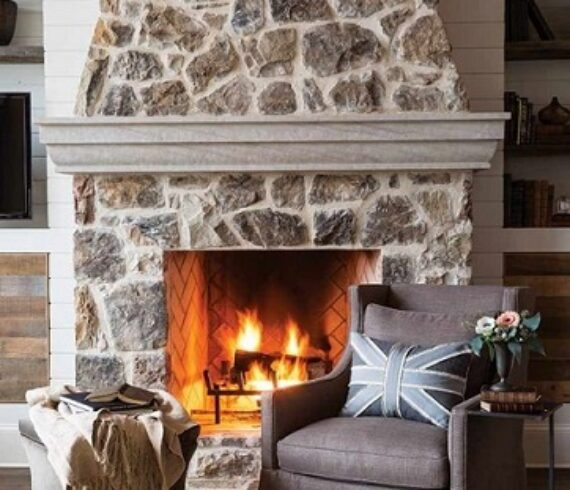
Nothing beats a wood burning fireplace – it creates a cozy atmosphere with its crackling fire and woody smell, creates family moments of nostalgia, creates a focal point in any room and doesn’t require a gas line and adds value to a home (by as much as $12,000!).
A wood burning fireplace is not without its drawbacks however. It’s more time-consuming to light, requires maintenance of sweeping embers and annual flue inspections/cleaning, is a less efficient heat source, can produce unwanted smoke, is harder to install, is more expensive and requires the purchase and storage of wood as its fuel.
A brick wood burning fireplace can cost between $8,500 – $22,000: $5,500 to $11,000 for labor and materials; $2,500 to $10,000 install depending upon whether if there is a chimney in place; $500 and $1,000 installing a new firebox and $60 to $95 per linear foot.
http://mychimpro.com/everything-you-need-to-know-wood-fireplaces/
https://ibuyer.com/blog/does-a-fireplace-add-value-to-your-home/
https://www.fixr.com/comparisons/wood-vs-gas-fireplace
Outdoor fireplaces are made of stone, stucco, stainless steel, or other materials, and have a number of options for fuel. While some DIY or home-built outdoor fireplaces may use wood for fuel, most high-quality fireplaces use propane to burn more cleanly, efficiently, and reliably. It is also possible to run a natural gas line to an outdoor fireplace in some cases, but this is generally difficult.
Outdoor fireplaces are among the trendiest and most sought-after outdoor features. The addition of an outdoor fireplace will add both character and value to your home. It will provide a warm gathering place where family and friends can make lasting memories together.
Depending on the fuel, model, and other factors outdoor fireplaces generally have BTU outputs between 30,000 and 100,000. That’s nothing to take lightly. While we wouldn’t expect anyone to be having any mid-January backyard pajama parties thanks to their fireplace, they’re perfect for making a chilly evening on the patio cozy and comfortable.
As with indoor fireplaces, an outdoor fireplace requires cleaning and maintenance to keep it looking and working at its best. While an outdoor fireplace may not need to be cleaned as often, it will need to be cleaned regularly in order to keep it reasonably tidy and maintained and to remove ash build.
Be aware of local codes before installing your outdoor fireplace. Consider the distance to the nearest structure, proximity to your property line, chimney height, etc.
Cost depends on a number of factors, including brand, model, installation, and more. A simple wood-burning fireplace could go for as little as a few hundred dollars, while high-quality propane models sometimes sell for several thousand. If you want an outdoor fireplace, you should be able to find something in your price range.
Everything You Need to Know about Outdoor Fireplaces – Brothers Pool Blog
Pros and Cons of Different Outdoor Fireplaces – US Brick and Block
Call Talie Jane Interiors at 855-TALIE JANE (855-825-4352) for help with your fireplace design.
Article by the Talie Jane Interiors team.
Images sourced from Pinterest.